Updated: Jan 2026 | Author: Web3TradingHub (Zubair)
Table of Contents
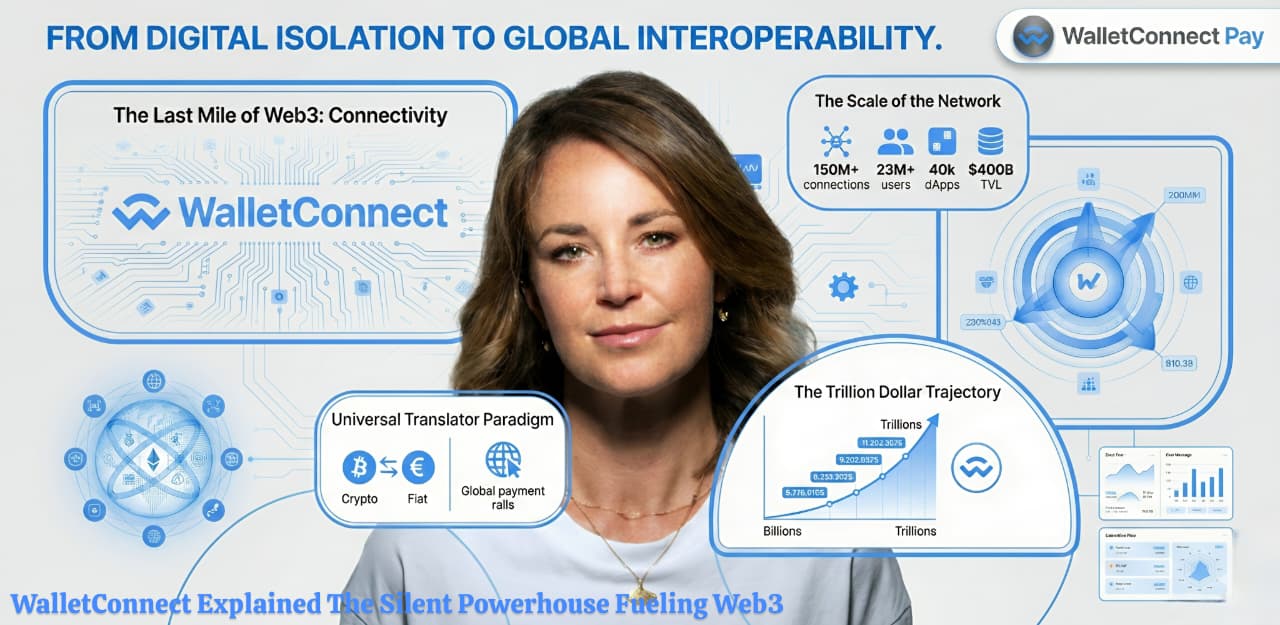
Volatility captures the headlines but fragmentation is the true barrier to crypto adoption. The friction of incompatible wallets and isolated protocols has long stifled the user experience. WalletConnect has emerged as the definitive solution acting as the invisible infrastructure layer that unites the Web3 ecosystem.
If you have utilized a QR code to access a dApp you have interacted with this protocol. This guide analyzes the technical architecture the utility of the WCT token and the innovation of Smart Sessions to explain why this infrastructure play is a critical narrative for the upcoming cycle.
In this deep dive, we aren’t just looking at what it is. We are exploring the WCT token, the new “Smart Sessions, and why this infrastructure play might be the most undervalued narrative of 2025.
Part 1 What is the WalletConnect Protocol
WalletConnect is not merely an application it is an open source communication protocol establishing a standard language that enables seamless interaction between diverse wallets and decentralized applications. Functioning as the interoperability layer of Web3 it operates similarly to Bluetooth technology. Just as Bluetooth creates a universal connection standard between disparate devices WalletConnect eliminates compatibility barriers allowing users to securely connect their preferred wallet to any protocol without restriction.
How it Works
- The dApp displays a QR Code (or a deep link on mobile).
- You scan it with your mobile wallet (e.g., Rainbow, Trust Wallet, MetaMask Mobile).
- A secure Tunnel is created. The dApp can send transaction requests to your phone, and you sign them securely on your device.
- Security: Your private keys never leave your phone. The dApp never sees them.
Part 2 The Visionaries Who Built This?
WalletConnect wasn’t built by a faceless corporation. It started in 2018 by Pedro Gomes, a developer who was tired of the MetaMask Monopoly. He wanted a world where users could choose any wallet they wanted.
The 2025 Evolution:
- Foundation: In late 2024, the WalletConnect Foundation was launched to decentralize the network.
- WCT Token: The introduction of the WCT token marks a shift from a public good to a decentralized, incentivized network.
- CEO: Jess Houlgrave is now leading the charge, focusing on UX that rivals Web2 apps like Venmo.
Part 3 Strategic Importance for Traders
Market participants often neglect infrastructure analysis yet in decentralized markets infrastructure dictates liquidity. The value of WalletConnect lies in its ability to streamline execution and act as a chain agnostic hedge.
The Smart Session Revolution
The evolution from legacy protocols to Smart Sessions represents a paradigm shift in user experience. Previously users were forced to manually authorize every individual transaction creating significant drag on execution. The introduction of Smart Sessions allows for a single authentication to authorize pre approved parameters for a specific duration. This reduction in latency creates a seamless execution environment offering high frequency DeFi traders a significant competitive advantage by removing mechanical friction.
The WCT Token Narrative
Infrastructure assets like Chainlink or The Graph historically command premium valuations due to their chain agnostic nature meaning they succeed regardless of which Layer 1 blockchain dominates the market. The WCT token captures this value through tangible utility. Holders can stake assets to secure the relay network earning fees in return while governance rights allow investors to steer the future development of the protocol.
Part 4 WalletConnect vs. The Competition
| Feature | WalletConnect | Browser Extensions (e.g., MetaMask) | Hardware Direct |
| Mobility | High (Use any device) | Low (Stuck on one PC) | Low (Need cables) |
| Security | High (Keys on mobile/cold) | Medium (Hot wallet risk) | Very High |
| Compatibility | 6,000+ Apps | Limited to supported chains | Very Limited |
| User Experience | Scan & Go | Download & Setup | Plug & Play |
Part 5 The Evolution of the Tech Stack
The narrative surrounding WalletConnect has historically focused on its utility as a simple bridging tool a passive pipe connecting a user to a protocol however the development team has recently executed a strategic pivot transforming the protocol from a mere connector into a comprehensive full stack development platform now operating under the rebrand Reown this evolution addresses the critical fragmentation layers of Web3 focusing on onboarding communication and financial primitives.
AppKit The Unified Onboarding Engine
The most significant upgrade in the recent cycle is the deployment of AppKit previously known as Web3Modal this is not simply a UI update it is a fundamental restructuring of how users enter the blockchain ecosystem historically the barrier to entry for decentralized applications was the requirement of a pre existing browser extension wallet requiring users to manage seed phrases before their first interaction AppKit dismantles this barrier by integrating Email and Social Login functionality directly into the connection interface.
By leveraging Multi Party Computation MPC technology AppKit allows a user to generate a non custodial wallet simply by logging in with a Google or Apple ID or an email address this creates a seamless “Web2 like” experience where the cryptographic complexity is abstracted away from the end user for developers this is a game changer as it dramatically increases conversion rates by removing the friction of wallet creation at the point of interaction furthermore AppKit unifies the connection experience across mobile and desktop ensuring that the interface remains consistent regardless of the device or operating system being utilized.
Web3Inbox The Communication Standard
One of the most dangerous flaws in the previous iteration of the crypto stack was the silence between the protocol and the user once a transaction was submitted the dApp had no way to communicate with the wallet owner this led to significant capital inefficiency and risk particularly in DeFi where users would often discover they had been liquidated only after the fact Web3Inbox solves this by introducing a decentralized notification layer directly into the wallet infrastructure.
This creates a direct line of communication where protocols can send push notifications regarding critical on chain events if a loan health factor drops below a certain threshold on Aave or if a governance proposal is open for voting on Uniswap the user receives an instant alert this transforms the wallet from a passive storage device into an active engagement tool the implications for risk management are profound as traders can now react to market volatility in real time without needing to constantly refresh a dashboard this notification layer is also chain agnostic meaning it aggregates alerts across all networks into a single inbox reducing the cognitive load on the active investor.
Integrated Financial Primitives
Moving beyond simple connectivity the protocol has integrated financial primitives directly into the connection modal creating what is effectively an embedded DeFi layer this feature set allows users to execute Swaps and On Ramps without leaving the dApp interface previously if a user wanted to interact with a protocol on the Base network but only held funds on Ethereum Mainnet they would have to navigate to a third party bridge perform the transaction wait for confirmation and then return to the dApp.
With the new upgrades incorporated into the AppKit users can bridge and swap assets directly within the connection modal this reduces the number of steps required to execute a trade and significantly lowers the drop off rate for new users additionally the integration of fiat on ramps means users can purchase cryptocurrency directly with a credit card at the point of interaction this is building the standard for an on chain payment layer bridging the gap between crypto wallets and real world capital injection by embedding these financial tools into the infrastructure WalletConnect is effectively becoming the operating system for Web3 interaction rather than just a passive link.
Smart Accounts and Account Abstraction
The underlying architecture has also been upgraded to support ERC-4337 or Account Abstraction which enables Smart Accounts unlike traditional Externally Owned Accounts EOAs which require a private key for every signature Smart Accounts are programmable contracts this enables features like gas sponsorship where the dApp pays the transaction fee for the user and transaction batching where multiple operations are bundled into a single click.
This upgrade aligns with the broader industry move towards Invisible Crypto where the technical mechanics of gas fees and chain switching are handled in the background the WalletConnect infrastructure now supports these programmable interactions allowing developers to build sophisticated user journeys that feel indistinguishable from traditional fintech applications this move towards Account Abstraction is critical for mass adoption as it allows for the implementation of spending limits recurring payments and social recovery methods that make self custody safer and more user friendly for the average participant.
The Strategic Pivot to Reown
It is important to understand that these upgrades are part of a larger corporate restructuring under the Reown brand while the protocol itself remains open source and decentralized the tooling built on top of it is now designed to provide a cohesive developer experience this shift signals that the project is moving beyond the “public good” phase and entering a “infrastructure dominance” phase aiming to be the default toolkit for every builder in the space by owning the onboarding communication and execution layers Reown positions itself as the most critical middleware in the entire crypto stack ensuring that as the ecosystem grows the reliance on this infrastructure only deepens.
6. Risks
No protocol is perfect. Here are the risks you need to watch.
- Phishing Risks: Scammers can create fake Connect Wallet popups. Always verify the URL of the dApp before scanning the QR code.
- Centralization of Relays: Currently, most connections go through WalletConnect’s own servers. The goal of the WCT token is to decentralize this, but it’s a work in progress.
- User Confusion: New users often confuse WalletConnect with a wallet itself. It is not a wallet it is a bridge. Here
Conclusion
When the next 100 million users enter crypto, they won’t be writing down seed phrases or installing Chrome extensions. They will be using mobile apps with social logins, powered invisibly by WalletConnect.
Your Action Plan:
- Audit Your Setup: Are you still using a browser extension for everything? Try moving to a mobile-first workflow with WalletConnect for better security.
- Watch WCT: Keep an eye on the governance and staking utility of the new token.
- Stay Safe: Remember, WalletConnect is just a pipe. If you connect to a malicious dApp, the pipe will still drain your wallet. Verify every connection.
The future is connected. Make sure you are too.
Frequently Asked Questions (FAQ)
Q: Is WalletConnect safe to use? A: Yes, the protocol itself is secure. It uses end-to-end encryption. However, it connects you to dApps. If the dApp is malicious, your funds are at risk. Always disconnect sessions after use.
Q: Does WalletConnect charge fees? A: No. The protocol is free for users. Wallets and dApps may pay fees for advanced features, but the basic connection is free.
Q: Can I use WalletConnect with a Ledger? A: Yes! You can connect your Ledger to “Ledger Live” mobile app, and then use WalletConnect to interact with DeFi apps while keeping your keys offline.
Q: What is the WCT token used for? A: WCT is used for governance, staking to run relay nodes, and potentially for payment of premium services within the WalletConnect ecosystem.
⚠️ Financial Disclaimer
The information provided on Web3TradingHub.com is for educational purposes only. I am not a financial advisor. Cryptocurrency investments and DeFi protocols involve high risk. Always conduct your own due diligence (DYOR) and never invest money you cannot afford to lose.