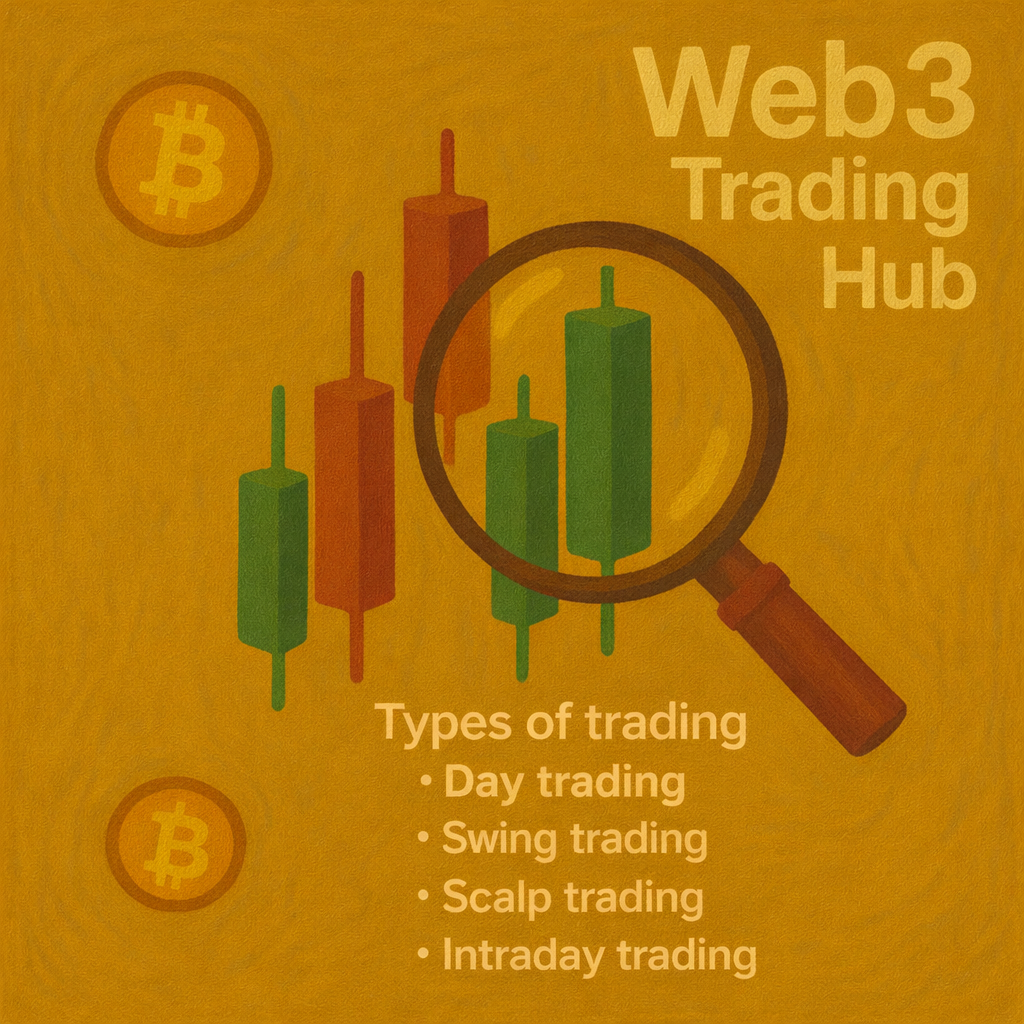
Updated: Dec 2025 | Author: Web3TradingHub Team
Table of Contents
Let me share a secret about my journey. I still clearly remember my first year in the markets. I was glued to the screen for twelve hours a day, frantically jumping from scalp trading to swing trading, and bleeding money on fees every single week. I convinced myself that the problem was the market manipulation or bad luck. In reality, the problem was that I did not know who I was as a trader. I was trying to sprint in a marathon and sleep during a sprint.
Trading isn’t a one-size-fits-all t-shirt. It is a custom suit. If it does not fit your unique personality, your specific risk tolerance, and your daily schedule, you will be uncomfortable, you will make emotional mistakes, and you will lose money.
Whether you are a complete beginner looking to make your first trade or a seasoned veteran refining your edge, this guide is your ultimate roadmap. We are going to strip away the noise and look at the mathematical and psychological realities of the major types of trading styles dominating the 2025 market. We will explore how to identify which style fits your life, how to manage risk effectively, and how to stop gambling and start operating like a business.
1. Day Trading Guide (Intraday Trading)
Best For: Adrenaline junkies, analytical thinkers, and those who can treat trading like a full-time job.
Day trading is exactly what it sounds like. It involves the buying and selling of assets within the same trading day. The golden rule here is No Overnight Risk. When you close your laptop at the end of the session, your portfolio is 100% cash or stablecoins. You sleep like a baby because you simply do not care what the market does while you are dreaming. If the market crashes overnight, it does not affect you because you have no open exposure.
The Mechanics of Day Time Trading
In the world of day trading, you are capitalizing on short-term volatility. In 2026, with assets like Bitcoin and Ethereum often swinging 3% to 5% daily, the opportunities are endless. A successful daytrader does not care if the asset goes to the moon in ten years; they only care if it moves five percent in the next two hours.
To succeed in day to day trading, you need to rely heavily on technical analysis. You are not looking at the long-term fundamentals of a company or a crypto project. You are looking at volume, price action, and order flow. You are looking for imbalances in supply and demand that you can exploit for a quick profit.
Strategies for Intraday Trading
One of the most popular day trading strategies involves momentum trading. This is where you identify stocks or coins that are moving with high volume and jump on the wave. You ride the momentum up and sell as soon as you see signs of reversal. Another common strategy is range trading, where you identify support and resistance levels and trade the bounces between them throughout the session.
For those interested in intraday trading for beginners, it is crucial to understand that this style requires intense focus. You cannot day trade while working another job or while distracted. You need to be watching the charts, the level 2 data, and the news feeds constantly.
Tools Required
You cannot execute day trading strategies with a slow phone and bad internet. You need a fast computer, possibly multiple monitors to watch different timeframes, and a direct access broker that offers low fees and fast execution. You will also need a reliable intraday screener to find the best stocks for intraday trading each morning before the market opens.
Pros and Cons
The biggest advantage of day trading is the lack of overnight risk. You start every day fresh. You also get instant feedback on your performance. The downside is the stress. It is a high-performance activity that can lead to burnout if you do not manage your mental energy well. Furthermore, it requires significant capital because of the Pattern Day Trader rule in stocks or the need for size to make small moves meaningful in crypto.
Shutterstock
2. Swing Trading Guide
Best For: People with day jobs, patience, and a strategic mindset.
If day trading is a machine gun, swing trading is a sniper rifle. A swingtrader isn’t interested in the noise of the 1-minute chart or the stress of watching every tick. You are looking for multi-day moves. You might hold a position for three days or three weeks. This style allows you to capture the meat of a market move without being glued to your screen all day.
How Swing Trading Strategies Work
The core philosophy of swing trading is identifying a trend and capturing a significant portion of it. You rely on technical analysis to find entry points, but you also use fundamental analysis to ensure you are trading an asset that has a reason to move. For example, you might look for a crypto token that has a major upgrade coming up next week. You buy the rumor and sell the news.
Unlike the daytrader who panics at a 1% drop, a swing trader expects volatility. You set wider stop losses to give the trade room to breathe. You are not trying to catch the exact bottom or the exact top; you are trying to catch the middle 60% of the trend.
Comparing Day Trading vs Swing Trading
The biggest difference is time. Intraday trading requires you to be present during market hours. Swing trading allows you to do your analysis in the evening or on the weekends. This makes it the ideal style for those who want to learn how to trade while keeping their full-time job.
Another difference is the frequency of trades. A day trader might take five trades a day. A swing trader might take five trades a month. This lower frequency means you pay less in fees and have more time to think through your decisions.
Tools for the Trader Swing Style
You need good charting software like TradingView to map out your support and resistance zones. You also need a calendar of economic events to know when volatility might hit the market. Since you hold positions overnight, you need to be aware of the forex market hours or crypto maintenance schedules that might affect liquidity.
Pros and Cons
The main pro of swing trading strategies is the lifestyle. It is low stress compared to scalping. It allows for a balanced life. The con is overnight risk. You are holding assets while you sleep. If a major news event breaks out at 3 AM, you could wake up to a significant loss if your stop loss is not respected by a gap down in the market.
Getty Images
3. Scalping (Scalp Trading)
Best For: Gamers, data nerds, and those with zero patience.
Scalp trading is the most intense, high-speed form of trading available. You are entering and exiting trades in seconds or minutes, aiming for tiny profits of 0.1% to 0.5%. But you do this 50 to 100 times a day. The goal is to accumulate small wins that add up to a large daily profit.
The Reality of Scalping
Scalpers serve as liquidity providers to the market. They are buying at the bid and selling at the ask, or trying to capture very small imbalances in the order book. This requires a very specific personality type. You must be able to make decisions in split seconds without hesitation. If you hesitate, the opportunity is gone.
This style is often confused with day time trading, but it is faster. A day trader might hold a trade for two hours. A scalper rarely holds a trade for more than two minutes.
The Hidden Trap: Fees
In scalp trading, the exchange is your enemy. If your trading fee is 0.1% and you make a 0.15% profit, you actually lost money after the round-trip fee. You need tight spreads and high liquidity. This is why scalpers often gravitate towards major forex pairs or high-volume crypto assets like Bitcoin. They cannot trade illiquid altcoins because the spread would eat all their profits.
Tools and Environment
You need professional grade tools. You cannot scalp effectively on a mobile app. You need hotkeys to enter and exit trades instantly. You need a fast internet connection with low latency. Many scalpers use level 2 market data to see the pending orders and predict where the price will move in the next few seconds.
4. Position Trading (The Macro Investor)
Best For: Visionaries who ignore daily noise and prefer long-term wealth.
Position trading is the HODL strategy with a brain. Position traders hold assets for months or years. They do not care about a 10% drop today because they are betting on a fundamental shift in the market over the next two years.
The Strategy Behind Position Trading
You rely on Fundamental Analysis rather than lines on a trading chart. You are looking at network adoption, Halving cycles, Interest rates, and global macroeconomics. This is less about trading chart patterns and more about understanding the value of the asset.
For example, a position trader might buy Ethereum because they believe that decentralized finance will replace traditional banking in the next five years. They are not worried about what the Federal Reserve says tomorrow. They are focused on the thesis.
Patience is the Key
This style requires the most patience. You might go months without seeing a significant profit. You have to sit on your hands and do nothing, which is often harder than active trading. However, the tax benefits are often better because you are holding for the long term, avoiding short-term capital gains taxes in many jurisdictions.
5. Algorithmic Trading (Algo Trading)
Best For: Coders, statisticians, and tech-savvy traders.
Why trade yourself when a bot can do it for you? In 2026, algorithmic trading software is accessible even to retail traders. These bots can execute strategies 24/7 without fear, greed, or sleep. They follow a strict set of rules that you define.
The Rise of Algo Trading
Algo trading has taken over the markets. It is estimated that over 70% of volume in the US stock market is driven by algorithms. These bots can spot inefficiencies that a human eye would miss. They can execute arbitrage opportunities between exchanges in milliseconds.
For a beginner, getting into algo trading can be daunting. It usually requires learning some coding, often Python, or using sophisticated drag-and-drop platforms. You need to understand how to backtest your strategy against historical data to see if it would have made money in the past.
The Reality Check on Bots
Most passive income bots sold online are scams. A real algo trading strategy requires constant maintenance. The market changes, and an algorithm that worked last month might fail this month. You need to constantly tweak your algo trading algorithms to adapt to new volatility regimes.
Understanding algo trading programming gives you a massive edge. You can automate your risk management, ensuring you never lose more than you planned. You can also monitor dozens of charts at once, something a human cannot do.
Comparison: Which Types of Trading Fit You
Choosing between these styles is critical. Let’s break it down further.
- Time Commitment: If you have a full-time job, intraday trading is likely impossible for you. You will miss the best moves while you are in a meeting. In this case, swing trading strategies or position trading are your best options.
- Personality: Are you impatient? Do you need constant action? Then scalp trading might fit you. Are you analytical and slow to decide? Then position trading is better.
- Capital: Day trading typically requires more capital to be effective, especially in stocks where regulations apply. Swing trading can be started with smaller amounts since you are catching larger percentage moves.
If you are just starting to learn how to trade, it is recommended to start with swing trading. It gives you time to think and correct your mistakes, unlike the brutal speed of scalping.
Intraday Stocks for Today: How to Pick
For those committed to the day trading path, the biggest challenge is selection. With thousands of assets available, how do you choose? You need to look for volatility and volume.
You should use a scanner to find the best stocks for intraday trading every morning. Look for “Gap Ups” or “Gap Downs” stocks that are opening significantly higher or lower than they closed yesterday. These stocks will have the attention of the market.
Look for the best share for intraday trading that has a catalyst. Is there news? Earnings report? An FDA approval? A partnership announcement? These catalysts provide the fuel for the price movement you need. Do not trade a stock that is doing nothing; you will die of boredom and lose money on the spread.
Risk Management: The Survival Kit
It does not matter if you are a daytrader or using long-term strategies, if you do not manage risk, you will go to zero. The market is unforgiving.
The 1% Rule
Never risk more than 1% of your total account on a single trade. If you have a $10,000 account, your stop loss should be set so that you only lose $100 if you are wrong. This ensures that you can lose ten times in a row and still have 90% of your capital left to fight another day.
The Psychology of Loss
Amateurs try to be right. Professionals try to make money. There is a difference. A pro trader is happy to lose small three times in a row if their fourth trade covers all losses and brings a huge profit. You must detach your ego from the trade. A loss is not a reflection of your intelligence; it is just the cost of doing business.
Stop Losses are Non-Negotiable
Every trade must have a stop loss. For intraday trading tips, the most important one is to never move your stop loss further away. If the trade hits your stop, get out. Do not hope it will come back. Hope is not a strategy. Risk Management
Advanced Concepts: Algo and Software
As you advance, you might look into algo trading software. There are platforms now that allow you to build bots without code, but you must be careful. You need to understand the logic behind the bot.
Using algo trading algorithms allows you to remove emotion. A bot does not get scared when the market dumps. It executes the plan. However, a bot also does not have intuition. If a war breaks out, a human knows to pause trading. A bot will keep buying the dip until the account is blown, unless you have programmed a kill switch.
For those interested in algo trading programming, focusing on Python and libraries like Pandas and CCXT for crypto is the standard path. This allows you to build custom indicators and execution engines that are far superior to retail tools.
Developing Your Edge
To succeed in day to day trading or any other style, you need an edge. An edge is simply a statistical advantage. It means that over a series of 100 trades, your strategy makes more money than it loses.
You find your edge by journaling. You must track every trade. What was the setup? What time of day was it? Did you follow your rules? Over time, you will see patterns. Maybe you are terrible at trading in the morning but great in the afternoon. Maybe you lose money on Mondays but make money on Fridays.
For intraday trading for beginners, the best edge is often specialization. Do not try to trade everything. Master one setup on one asset. Become the expert on how Bitcoin moves between 8 AM and 10 AM.
Final Thoughts: Stop Guessing, Start Executing
Trading is a skill, not a lottery ticket. The market is a mechanism for transferring money from the impatient to the patient. It requires discipline, continuous learning, and emotional control.
Your next steps are clear. Pick ONE style from the list above. Do not try to be a scalper and a position trader in the same portfolio; it will confuse you. Open a Demo Account and prove you can be profitable with fake money before you risk your rent money. Start a Journal immediately. If you don’t track your trades, you aren’t trading you’re gambling.
The market in 2026 is full of opportunity. Whether you choose day trading, swing trading, or rely on algorithms, the potential is there. But it is only there for those who treat this seriously. Are you ready to capture it?
Frequently Asked Questions (FAQ)
Q: Can I start trading with $100? A: Yes, but your strategy changes. With $100, fees will eat up scalping profits. Your best bet is swing trading, where you catch larger percentage moves to grow your account. You cannot effectively do day to day trading with such a small amount due to fees and pattern day trading rules in some markets.
Q: Is Copy Trading safe? A: Copy trading is popular but risky. If the pro trader tilts or changes their strategy, you lose money too. Always check the Max Drawdown of a trader before copying them.
Q: What is the best indicator for beginners? A: Start with RSI. It is simple: If it is above 70, the asset is expensive. If it is below 30, it is cheap. This is useful for finding the best stocks for intraday trading and crypto alike.
Q: How do I handle taxes? A: In most jurisdictions, every trade is a taxable event. Use software like Koinly or CoinTracker to automate this. Do not try to do it manually in Excel.
Q: Which is better: Day Trading or Swing Trading? A: Neither is inherently better; it depends on your lifestyle. Day trading offers no overnight risk but requires high screen time. Swing trading offers a better work-life balance but carries overnight risk.
Q: Do I need to know coding for Algo Trading? A: While not strictly necessary due to new no-code platforms, learning basic algo trading programming gives you a significant advantage and allows you to audit the bots you are using.
Q: What are the best intraday stocks for today? A: The best stocks change daily. You must use a scanner to find stocks with high relative volume and a news catalyst. Never trade a stock just because someone on Twitter mentioned it.
Q: Is intraday trading profitable? A: Intraday trading is profitable for those who have a tested strategy and strict risk management. However, the majority of beginners lose money because they treat it like gambling rather than a business.
Q: What are common day trading strategies? A: Common strategies include Gap and Go, Bull Flag breakouts, and Reversal trading. Each requires specific rules for entry and exit.
Q: Can I do scalp trading on my phone? A: It is not recommended. Scalp trading requires speed and precision that a mobile touch screen cannot provide. You will likely lose money due to slow execution.
Q: What is a swingtrader? A: A swingtrader is someone who holds positions for days or weeks to capture medium-term market moves, avoiding the stress of intraday fluctuations.
Q: Where can I learn how to trade? A: You can learn through books, online courses, and by practicing on demo accounts. The most important teacher is experience and reviewing your own trade journal.
Q: What are the best intraday trading tips? A: The best tips are: protect your capital, never trade without a stop loss, and stop trading if you lose 3 trades in a row (take a break).
Q: How do I find intraday stocks for tomorrow? A: You can scan for stocks that closed strong near their highs or have earnings reports scheduled for the next morning. These are likely candidates for volatility.
Q: What is the difference between day trading and intraday trading? A: There is no difference. They are synonyms describing the same style of opening and closing positions within the same day.
Q: How do I start intraday trading for beginners? A: Start by learning technical analysis, open a demo account, and practice one single strategy for at least three months before using real money.
Q: Is day time trading stressful? A: Yes, it requires high concentration and emotional control. It can be stressful if you are risking money you cannot afford to lose.
Q: Does technical analysis work for a trader swing style? A: Yes, technical analysis is the primary tool for a trader swing style to identify entry and exit points on higher timeframes like the 4-hour or daily chart.
Disclaimer
The information provided on Web3TradingHub.com is for educational purposes only and does not constitute financial advice. Trading involves high risk and potential loss of capital. Past performance does not guarantee future results. Always conduct your own research and never trade with money you cannot afford to lose.